RUNDE'S ROOM: Math Games

Showing posts with label Math Games. Show all posts

Donut You Know ... A Fast No-Prep Math Game

25 July 2019
Runde's Room: Donut You Know Math Facts Game
Looking for more fun ways to incorporate a little extra math facts practice into your day?  This super fun, no prep math game is a huge hit in my classroom.  I've seen the idea floating around instagram and pinterest a few times, and decided to try it out.  My crews always love a little competition, and actually, practicing their math facts too, so this game became an instant winner.  They seriously love it.

Runde's Room: Donut You Know Math Facts Game
You start out by drawing a donut (hence the name - "Donut You Know".  We use whiteboards, but any surface can be used.

Runde's Room: Donut You Know Math Facts Game
Then you write your numbers around the donut (be intentional with the numbers depending on the skill you are practicing).  *These numbers can stay the same for all the rounds you play.*

Runde's Room: Donut You Know Math Facts Game
Then ... with dramatic flair ... announce the donut hole number and skill ... and watch the students go crazy as they try to solve all the facts first.  *No calculator allowed - mental math only.

We don't use a time limit - the first person, or pair, or group to solve all facts correctly wins.  When a group has finished, they yell, "check" and all groups pause - markers in the air.  I run over, do a quick check, and if all are correct, the game is done and we start again with a new number.  If they have an incorrect fact I hand the board back to them and say, "game on" - meaning they need to find their error and correct it and all other groups can go back to work, too.  It literally takes one minute to complete a round.

Runde's Room: Donut You Know Math Facts Game
To play a second round, just erase the numbers around the donut and in the donut hole - leaving the numbers on the donut.  Just change the skill and number in the middle of the donut hole and students solve all the facts again.


Runde's Room: Donut You Know Math Facts Game
This game can be used to practice all kinds of math skills:
  • adding, subtracting, multiplying, dividing
  • whole numbers and decimals
  • adding or subtracting fractions
  • doubling and halving
  • tripling and thirding
  • multiplying by powers of 10
  • mental math strategies
  • number talk strategies


Check out these other fun ways to help your students master those tricky math facts:

0

Using Task Cards with Board Games

25 September 2016
A set of task cards and any blank board game makes an engaging yet rigorous way to help your students master math concepts.
My students love task cards - especially ones that get them moving.  That's exactly why I created my Math Circles - sets of task cards that get my students up and moving while learning and mastering the concepts.  So engaging for all students and absolutely perfect for your kinesthetic learners.  If you're anything like me, you have probably have tons of sets of task cards in your teacher stash already.  One day last year, while I was figuring out ways to use my task cards in more engaging ways, I had an awesome thought.  I wanted a GIANT game board so we could "play math" in a GIANT way.  So, I made it my plan to accomplish this during the summer.  I'm so glad I did - our giant game board has been an amazing addition to our math classes, and whenever my students literally BEG me to "play math", I know I've got a winner.

Make the Game Board
A set of task cards and any blank board game makes an engaging yet rigorous way to help your students master math concepts.
I ordered my game board through Vistaprint.  It is a 4 x 8 vinyl banner.  If you create an account with Vistaprint, they have some amazing sales and promo codes they will keep you informed about.  I waited until they had a good sale going to buy the banner.  I bought some board game clip art from Zip-a-Dee-Doo-Dah Designs and resized the game board a bit in photoshop (powerpoint would work, too) so it would fit.  I resized it to 24 x 48 inches and when I uploaded it in Vistaprint, the image worked perfectly - it's nice and crisp and fills the banner perfectly.

Now, go big or go home doesn't apply here.  You don't have to make a giant banner - anything would work.  You could draw a game board on bulletin board paper (it would make an awesome permanent bulletin board if you pinned the game pieces on it - a bulletin board you don't have to worry about changing ALL year long).  You could also use a large piece of cardboard - get your students involved in drawing the actual game board!  You could also do this on a smaller scale on regular paper so you could use it as a math station.  Anything goes!

A set of task cards and any blank board game makes an engaging yet rigorous way to help your students master math concepts.
Last year when I thought of this idea, I tried it out by projecting an image of a game board on my whiteboard (there are tons of free blank game boards available when you search on google images).  We just used whiteboard markers to track our progress around the board.  Quick and easy and best of all - no prep.

To go along with our GIANT game board, I decided we just had to have some GIANT dice, so I found some on Amazon (I have included my affiliate link below this post).  You can use almost anything for the game pieces - I have a fun little collection of "ugly dolls" (they are just too cute to be ugly) in my classroom that work perfectly.

A set of task cards and any blank board game makes an engaging yet rigorous way to help your students master math concepts.

Play the Game
A set of task cards and any blank board game makes an engaging yet rigorous way to help your students master math concepts.I used my Place Value Math Circle to break in our new game board (but could use any set of task cards - and this doesn't just have to be limited to math).  We rolled out our board game in a nice open area and I divided the class into two teams.  I had previously printed out the numbers for the game (the same set of numbers can be used with many of my math circles) and have made them into necklaces with string and a clip.  These hang on a hook in my classroom and we use them often.

I handed the first team the first card from the math circle.  They had to read the instructions and arrange themselves into the number on the card (numbers are written in different ways on different cards - in word form, expanded form, by place value column, and greater than and less than form).  When they were finished, the opposite team examined the card and determined whether the number the first team made was correct or incorrect.  If correct, the first team got to roll the dice and move the number of spots indicated.  If they were incorrect, they did not get to roll the dice or move.  Then, the second team got the next card in the math circle - and followed the same procedure.  Repeat.  If you are using 2 dice, the game goes quite quickly - if you want to make the game last longer, only roll one.

A set of task cards and any blank board game makes an engaging yet rigorous way to help your students master math concepts.
In the picture above, students were asked to build a number that was 1000 greater than 6,588,301. I also have sets that fit both the US and Canadian way of writing the numbers (either with commas as place value holders, or spaces). 

A set of task cards and any blank board game makes an engaging yet rigorous way to help your students master math concepts.And that's it.  SO much fun.  When we were finished, we came back to the classroom to reflect on our activity.  I posted a question from my Math Reflection Fans and asked them to answer the question on a sticky note which we then posted.  You could also just have them write their answers on a large piece of chart paper (whole group graffiti style) or on the whiteboard. 

My students are already asking when we're using the game board again ... and I have to admit, I can't wait!!!  I've got a Rounding Math Circle that will be perfect for the end of the week!


3

5 Activities for Teaching Place Value

24 August 2016
5 Fun Hands-On Activities for Teaching Place Value that your students will LOVE!
I'm back with an all new "5 Activities for Teachingpost (click the link for more 5 Activity Ideas).  This one is all about Place Value.  Like many of you, I always like to start my math year with Place Value.  This post aims to take you past the traditional hands-on activities that students need like building and exchanging numbers using base 10 blocks, and hopefully gives you some new ideas to add to your collection.

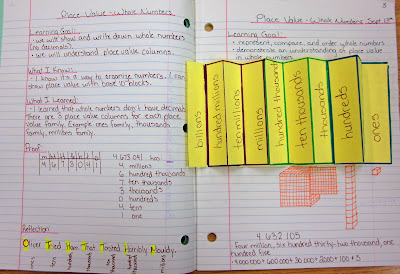
1.  Interactive Math Journals - I always like to introduce new math concepts with an entry or two in our Interactive Math Journals.  I've got some fun ideas here on my blog that you can read some more about.  This one is from my original Interactive Math Journal.  Students identify the place value column of the highlighted digit.  You can see it HERE.
5 Fun Hands-On Activities for Teaching Place Value that your students will LOVE!

Another math journal idea is from my Interactive Math Journal 2.  This one has students identifying the place value columns from billions all the way up to the billions column.  You can read more about it HERE.
5 Fun Hands-On Activities for Teaching Place Value that your students will LOVE!

5 Fun Hands-On Activities for Teaching Place Value that your students will LOVE!
2.  Cup-Stacking Place Value Game - This one is SO much fun!  You need styrofoam cups (or any cups with a lip so you can write a digit on the lip).  Label each cup with a digit from 0-9 (I used a sharpie for this, and I wrote the digit on both sides of the lip).  Repeat for the number of cups you have.  The number of cups you need depend on the number of students playing, and how high you wish your numbers to go.  For a group of 3, playing to the hundred thousands, you will need 18 cups.  (I bought a pack of 20 at the dollar store).  To work with numbers in the billions, students would build a pyramid with 10 cups.


5 Fun Hands-On Activities for Teaching Place Value that your students will LOVE!

Spread the cups out and have your students seated around them.  
5 Fun Hands-On Activities for Teaching Place Value that your students will LOVE!

5 Fun Hands-On Activities for Teaching Place Value that your students will LOVE!As quickly as they can they need to stack 6 random cups in a pyramid, then collapse the pyramid so they have a stack of 6 cups.  The first person to read the 6 digit number the stack makes, wins.  To get all participating and keep the motivation going, you can give the first person 2 points, and everyone else in the group that reads their number correctly 1 point.  Or, you can simply make this a math station without any points at all.  :)  Take a peek at this video to see how we play it.


5 Fun Hands-On Activities for Teaching Place Value that your students will LOVE!3.  Math Stations - Dice, cards, dominos ... all of these manipulatives are great for building numbers to have students work with place value.  I have a fun package of math station sheets for place value that use dice - whole numbers and decimals are included (US and Canadian versions are both included in the resource).  With this Rolling Place Value resource, students will be working with standard, written, and expanded form of numbers.
To use less paper, I bought these great dry-erase pockets at Amazon.  LOVE them.  Just slide the sheet inside, and let the students work.  I'll include an affiliate link to Amazon at the bottom of this post.  If you want to take a peek at this Rolling Place Value Resource, click HERE.
5 Fun Hands-On Activities for Teaching Place Value that your students will LOVE!

I also have a similar resource for rounding - including numbers from millions to thousandths on individual sheets so you can easily differentiate for your students.  Students will also compare and order the numbers they made.  To see this Rolling with Rounding Resource, click HERE.  Each of these two "rolling" resources include an extra page that students can complete and hand in for a formative assessment.
4.  Place Value Scavenger Hunt - I've got a fun little freebie to share with you.  This Place Value Scavenger Hunt has students hunting for numbers - around the school, in a newspaper or magazine, online ... wherever you choose to have your students look.  I'm planning on having my students work in groups, giving each group an iPad.  When they find one of the numbers on their scavenger hunt, they can take a picture of it on the iPad.  At the end of the activity, they will go through their gallery, showing the 15 pictures.  To grab a free copy for your classroom, just click HERE.

5 Fun Hands-On Activities for Teaching Place Value that your students will LOVE!

5 Fun Hands-On Activities for Teaching Place Value that your students will LOVE!5.  Place Value Math Circle - This Place Value math circle is always a hit in my classroom because it gets us up and moving, and really exploring numbers.  It is especially beneficial for the kinesthetic learners in the classroom.  This math circle is similar to my drama circles in that everyone gets a card with a direction to follow.  Each student is given a digit from 0-9, there is a decimal for someone to wear as well.  Once everyone is wearing their digit, the first person reads the instruction on the card and builds the number using people in the class.  For example, in the picture below, the card said, "Use 5 people to build a number with a 2 in the ten thousands place, 4 in the thousands place, 9 in the hundreds place, 6 in the tens place, and 3 in the ones place.  Read the number aloud."  I have both a US version and a Canadian version available.
5 Fun Hands-On Activities for Teaching Place Value that your students will LOVE!

5 Fun Hands-On Activities for Teaching Place Value that your students will LOVE!

And that's about that.  What are some of your best tried-and-true place value activities in the classroom?  Leave a comment below explaining all about it.


7

5 Activities for Teaching Fractions

04 July 2016
5 Hands-On Activities for Teaching Fractions that your Students will LOVE!
5 Activities for Teaching Fractions

I've got another fun 5 Activities to Teach ... post for you today.  This one is all about fractions!  I LOVE teaching fractions - there are so many engaging ways to get your students involved in their learning in a hands-on way!


1.  Fraction Pizzas - We started off our Fraction Unit this year with a super fun Fraction Pizza themed day.  Oh my goodness - this is definitely something I will continue to do - we ALL had a blast!  We started out by making Paper Plate Fraction Pizzas.  This is something I've done before in our Interactive Math Journals (there is a full entry in my Math Journal resource, or you can read more about it and other fraction journal ideas in my blog post HERE.)  This time we completed the pizzas outside of our journals so we could display them for all to see (we glued our fraction pizzas to a paper with a napkin and some cutlery for a fun display).  Under their napkins, students had to write about the equivalent fractions they used in their pizzas.

5 Hands-On Activities for Teaching Fractions that your Students will LOVE!

5 Hands-On Activities for Teaching Fractions that your Students will LOVE!
But we didn't stop there - we actually MADE our fraction pizzas.  I had all the ingredients out, and divided the class into 3 teams.  We made chef hats out of construction paper and tissue paper for the full effect.  We did a full-out FoodTV competition - with each team working in relay style to complete the pizzas - each student had two minutes to work on their task before they tagged the next person on their team to take over - continuing until their pizzas were completed.  They had to sauce the pizza (we used premade pizza crusts), cut the meat and veggies (with plastic knives), shred the cheese - all according to the recipe cards we had (which was the same recipe we used to make our paper plate pizzas).  When all the teams were done, we baked the pizzas and had a fun lunch together.

5 Hands-On Activities for Teaching Fractions that your Students will LOVE!But ... we didn't even stop there.  We saved the best for last - we made CANDY pizzas for dessert!  I had a variety of candy out on display and gave the three groups 10 minutes to meet and plan their recipes for their candy pizzas.  We used the premade crusts again (but they weren't the most delicious for the candy pizza, so I think I will do cookie dough next time) and white icing for the "sauce" and let the students take over.  This fun fraction pizza day was seriously the best kick off to our fraction unit - and it was one of my students' top memories from the year.

If you want to give this a try with your class, I've uploaded the pizza recipe and candy pizza cards to google drive - you can download a copy for yourself HERE.  (I also plan on writing a more indepth blog post all about our Pizza theme day SOON).


5 Hands-On Activities for Teaching Fractions that your Students will LOVE!
2.  Fraction of the Day Question - Fractions are just too important a concept to keep confined to one unit during the year.  I have a little spot on my whiteboard where I write a "real-life" fraction question each day for students to answer.  They solve on a sticky note and place it under the question (they usually do this first thing in the morning).  Sometimes they draw the fraction, sometimes they find equivalent fractions, sometimes they convert to decimals or percents ... just keep changing it up.  The denominator changes based on the number of students actually present that day - so that keeps it fresh, too.  I don't mark the individual responses - it's just a practice question each day.  Taking it up takes less than 5 minutes, and keeps fractions in their heads all year long.

If you don't have room on a whiteboard, this would be perfect on a little display chalkboard, or even those awesome little lightboxes I'm seeing all over instagram this summer.

5 Hands-On Activities for Teaching Fractions that your Students will LOVE!3.  Fraction Clothespins - My favorite activity for comparing and ordering fractions is using clothespins on a clothesline.  I use little sticky labels for writing fractions on one side of the clothespin, and the decimal (or percent) on the other side.  Just hang a piece of string up in the classroom, and have students pick a clothespin or two to place on the line.  Equivalent fractions are clipped to each other.  I usually do this in two "rounds".  I give them time to put the clothespin up first.  Then, when everyone is done, I give them time to look at the clothesline and make any corrections that are needed (they can change their own pin, or any pin on the line).  If they are changing a pin, they have to justify why.  Quick and easy ... and so hands-on effective.  You can read more about this activity in a blog post I have HERE.

4.  Fraction Circle - We love using math circles in my class.  It gets us up and moving, and has the students collaborating with their friends to complete the task on the card.  We usually do the math circle the way it's intended, in a circle format, giving out cards to each of the students, but I put two fun twists on our Fraction Circle this year.  I used cards as exit slips or transition cards after different activities - calling out one or two cards for students to complete at various times during the day.  We also used the cards for a super fun board game activity.  I projected a game board onto my whiteboard (there are some fun ones online HERE) and pulled out the giant dice.  I split the class into two teams.  I read the first team a fraction card and gave them 1 minute to complete the task.  If they were correct, they got to roll the dice and move ahead on the game board (we used the whiteboard markers to track our place on the whiteboard).  Then the second team got to go.  Repeat until you're finished.  This was SO MUCH FUN!  And you can use almost any set of task cards or math circle for this.  I plan on printing a life-size gameboard through Vistaprint this summer so we can have more fun with games like this.

5 Hands-On Activities for Teaching Fractions that your Students will LOVE!

5 Hands-On Activities for Teaching Fractions that your Students will LOVE!5.  Stations, Stations, Stations - I found that using lots of math stations and centers was another hit during our fraction unit.  The students LOVED the fun, hands-on activities they were doing, and I LOVED that they were kept busy, engaged, and learning while I had time to work with small groups for some extra reinforcement.  In the task card stations, I had pattern blocks and plastic building blocks set out for students to work through the tasks - with the students handing in their recording sheets when complete for a quick formative assessment.  I also made a station with dice - after the first day I added in a more difficult set of dice (with larger numbers than the standard dice) - I called them the "challenge dice" and I couldn't believe what a hit they were.  I'm not sure if it was because I let them use the "special dice" or because I called it a challenge, but whatever it was, I'll take the results.  I posted all our Fraction Math Center task cards we used in this unit into a bundle you can find on TpT HERE.

Dominos and whiteboards were another fun math station activity.  Dominos are perfect because they are already in fraction format.  These were also the perfect activity for me to work with individual students or small groups.  The students were having fun and the "work with teacher group" didn't seem like work at all.

5 Hands-On Activities for Teaching Fractions that your Students will LOVE!Simply pick some random dominos from the tin and arrange in order from least to greatest for comparing fractions and finding common denominators.

5 Hands-On Activities for Teaching Fractions that your Students will LOVE!Or, work with a partner (or the teacher) and play Fraction Domino War.  Each person places a domino on their side of the whiteboard, and the student with the greatest fraction wins both dominos.  The student with the most dominos at the end wins.
5 Hands-On Activities for Teaching Fractions that your Students will LOVE!Pull a random domino from the tin and make equivalent fractions.

5 Hands-On Activities for Teaching Fractions that your Students will LOVE!Or, place the domino so that the higher number is on top (the numerator) and make mixed numbers from the improper fractions.
 Lastly, during our math stations, I added in another accountability factor this year.  When we had a large block of station time, with students visiting a number of stations, they had to complete a sticky note exit slip after they finished at each station (each station had a stack of different colored sticky notes at it).  They had to write something specific they learned about fractions at that particular station.  It did take a little modelling at first to teach how to write something specific to "prove" their learning ... but soon we went from "Today I learned about improper fractions" to "Today I learned how to change an improper fraction to a mixed number at the domino station.  You divide the numerator by the denominator to find the whole number, and then you have the fraction left over.  5/2 = 2 1/2."  At the end of all the stations, students collected all their sticky notes on the board, stapled them together, and handed it in for a math reflection.

5 Hands-On Activities for Teaching Fractions that your Students will LOVE!


Whew.  That's 5 ... and that's a lot.  I told you we had a ton of fun with hands-on fractions this year.  Please leave a comment below with some of your best hands-on fraction activities you like to do in the classroom.  We can all benefit from the sharing of ideas.  Be sure to check out all my "5 Activities for Teaching ..." posts HERE.


4

5 Activities for Teaching Angles

27 June 2016
5 Activities to Teach Angles
5 Activities for Teaching Angles

I love teaching angles - it's short and sweet, and the students always have a lot of success with it - which makes it all the better.  :)


1.  Interactive Math Journal Entry - this is one of my all-time favorite math journal entries.  I use this as a full-class introduction to angles - not as a station.  That way, I can gauge what knowledge they come to me with, and we can talk about what we will learn while studying angles.  This entry is included in my Interactive Math Journal Resource.  If you download the free preview, you can grab this lesson in its entirety.  You can also read about this activity in a blog post I have HERE.  
5 Activities to Teach Angles

2.  Tables, Whiteboards and Washi Tape -
Hands-on activities to teach angles
Get the tape out and get ready for some hands-on fun!  (You don't have to use washi tape - masking tape works perfectly fine, too).  To introduce angles at the beginning of our unit, we did a full group lesson on classifying angles.  I taped up a table, armed students with a whiteboard marker, and let them classify (acute, right, obtuse, and straight) as many angles as they could.  They LOVED this activity!  So everyone could fit around the table, I paired up the students so they could take turns marking angles on the table.

Hands-on activities to teach angles


5 Activities to Teach AnglesOnce we were masters at classifying angles, we could move on to measuring angles.  This is such a fun activity - perfect for practice at math centers!  We just used some fun washi tape to "draw" lines on our whiteboards.  We used 5 pieces of tape - and I told them the tape had to be straight and go across the board from one side to the other.  From there, students measured the angles made by the tape.  You could just leave it at this, but I turned this activity into a game by pairing up the students.  Each student had a different color of whiteboard marker.  The first student measured an angle (any angle of their choice) and wrote down the measurement using their color.  Then, the second student checked the answer.  If it was correct, they left it alone.  If it was incorrect, they erased the first answer and wrote the correct answer using their color (the second student).  The second student then got a chance to pick and measure an angle of their choice - recording the answer in their color.  At the end of the activity, the student with the most answers in their color (most correct answers) wins!  

    5 Activities to Teach Angles

    3.  TIME for Angles - This is a quick activity I do at various points throughout the day while we are studying angles.  (I also throw in a few days here and there just to review the concept).  At any given time, I ask the students what time it is on our analog clock (that is good practice just in itself).  I record the time and ask the students what kind of angle it is - acute, right, obtuse, straight.  I  also ask them to estimate the size of the angle.  When doing this, the students realized that each 5 minute interval was 30 degrees - so helpful for estimating.I just keep a running record on the board by the clock and try to get in at least 5 questions throughout the day.

    5 Activities to Teach Angles
    4.  What's in a Name? -  This one is another great station activity - and will also make a great math bulletin board display when students are complete.  I like to use grid (graph) paper for this activity, but it's not necessary.  Have the students write their names in block letters (all straight lines) on the paper.  Then, using a protractor, have the students measure all the angles they can find in their names.  This is also a great way to start to introduce adjacent angles (and complementary and supplementary angles).

    5 Activities to Teach Angles
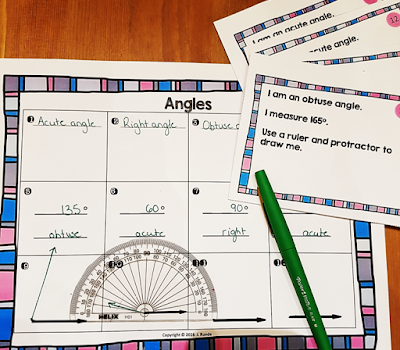
    5.  Angle Task Cards - This is another great station activity.  These Angle Task Cards contain a Minds-On Task which I like to use to introduce the concept to the whole class, with each student completing the challenge task on a whiteboard or paper.  The twelve task cards can then be completed independently as part of a station, with each student completing the recording sheet to hand in for a formative assessment.  The best part about the recording sheet is that it is perfectly matched up to the answer sheet, so you only need to place the recording sheet over the answer sheet in a light area (like a window) so you can see the answers through the page and easily mark without having to measure each angle.  These task cards also make great exit slips after a lesson.  You can take a peek at them on TpT by clicking HERE.

    5 Activities to Teach Angles


    Angle Relationships Task Cards

    I also have a more advanced set of task cards for angle relationships - finding the unknown angles with the properties of complementary and supplementary angles, opposite angles, and interior and exterior angles.  You can take a peek at them by clicking on the picture to the right or HERE.

    What are some of your best teaching ideas or activities for angles?  I'd love for you to leave a comment below to share with us.

    For more 5 Activities to Teach .... posts, click HERE.
    9