RUNDE'S ROOM: Math Stations

Showing posts with label Math Stations. Show all posts

Interactive Math Mat Warm-Ups for Upper Grades

17 August 2020
 
Runde's Room:  Interactive Math Mats for Upper Grades
I started using math mats as a quick warm-up activity last year for metric conversions.  It was a HUGE hit for all of us in the class.  The amount of visualizing and processing that happened in a short amount of time was amazing, and my students loved the interactive nature of it.  I loved that it gave me a quick comprehension check, and I could easily take note of which students needed a little extra reinforcement, and which concepts could benefit from more teaching.

Runde's Room:  Interactive Math Mat Warm-Ups
I shared this math warm-up idea on my Instagram account in March last year.  I made up a "Which is Greater" and "Which is Less" page and then wrote down a variety of measurements on little flashcards I cut up.  I also gave each student a little card with A on one side and B on the other.  For a quick warm-up (or review at the end of the lesson), I projected the math mat under my document camera.  I had all the measurement cards shuffled together in a pile.  Randomly flip two cards, saying, "Which is Greater - A or B?"  Give a little wait time and then have students hold up their cards at the same time with the correct letter facing out so you can see (if they hold up their cards in front of their chest and not in the air, it helps to not "sway" other answers in the class).  
We used this warm-up at the beginning of every class during our measurement unit with great success ... and then ... COVID.  lol.  So ... when I started to plan for this year (returning face to face in September ... have a wee bit of nervous energy to burn), I knew I wanted to create a set of math mats for place value, as well.

Runde's Room:  Interactive Math Mat Warm-Up Activities

These new Interactive Math Mat Resources can be used as math warm-ups or reviews, with a small group in a guided math lesson, or as a math station.  In these resources, I have included 6 different math mats to compare and order quantities, A/B and True/False answer cards for the students, and a huge quantity of number cards already prepped for you.  Just print and cut.  (I store these cards in a plastic baggie and use a binder clip to clip the bag to the math mats, which I laminate).  I have also included entrance and exit slips for all of the concepts covered in the resources so you can track students' progress at the beginning at end of the unit or mini-unit.

These math mat resources also come in a digital/printable combo version, if you're returning virtually this fall.  The digital resource contains a variety of math mats and interactive number cards so students can drag the cards over to complete the inequality statements.

Runde's Room:  Digital Math Mat Activities

You can take a peek at my newest Math Mat Resources HERE, or click on the pictures of the individual resources below.

Runde's Room:  Place Value Interactive Math Mats
The Place Value Math Mat Resource contains a set of number cards for decimals and whole numbers (from the thousandths to the millions).  Both sets contain a variety of numbers in standard, written, and expanded form.  

Runde's Room:  Metric Conversion Interactive Math Mats
The Metric Units Math Mat Resource contains three sets of quantity cards - for length, capacity and mass.  Metric prefixes include:  mm, cm, dm, m, km, mg, g, kg, mL, L, and kL.  
The Fraction Math Mat Resource contains mats for two different fraction skills:  Comparing Fractions and Operations with Fractions.  Fraction cards are in picture, number, and word form.


0

Donut You Know ... A Fast No-Prep Math Game

25 July 2019
Runde's Room: Donut You Know Math Facts Game
Looking for more fun ways to incorporate a little extra math facts practice into your day?  This super fun, no prep math game is a huge hit in my classroom.  I've seen the idea floating around instagram and pinterest a few times, and decided to try it out.  My crews always love a little competition, and actually, practicing their math facts too, so this game became an instant winner.  They seriously love it.

Runde's Room: Donut You Know Math Facts Game
You start out by drawing a donut (hence the name - "Donut You Know".  We use whiteboards, but any surface can be used.

Runde's Room: Donut You Know Math Facts Game
Then you write your numbers around the donut (be intentional with the numbers depending on the skill you are practicing).  *These numbers can stay the same for all the rounds you play.*

Runde's Room: Donut You Know Math Facts Game
Then ... with dramatic flair ... announce the donut hole number and skill ... and watch the students go crazy as they try to solve all the facts first.  *No calculator allowed - mental math only.

We don't use a time limit - the first person, or pair, or group to solve all facts correctly wins.  When a group has finished, they yell, "check" and all groups pause - markers in the air.  I run over, do a quick check, and if all are correct, the game is done and we start again with a new number.  If they have an incorrect fact I hand the board back to them and say, "game on" - meaning they need to find their error and correct it and all other groups can go back to work, too.  It literally takes one minute to complete a round.

Runde's Room: Donut You Know Math Facts Game
To play a second round, just erase the numbers around the donut and in the donut hole - leaving the numbers on the donut.  Just change the skill and number in the middle of the donut hole and students solve all the facts again.


Runde's Room: Donut You Know Math Facts Game
This game can be used to practice all kinds of math skills:
  • adding, subtracting, multiplying, dividing
  • whole numbers and decimals
  • adding or subtracting fractions
  • doubling and halving
  • tripling and thirding
  • multiplying by powers of 10
  • mental math strategies
  • number talk strategies


Check out these other fun ways to help your students master those tricky math facts:

0

Math Scavenger Hunts

13 August 2018
Runde's Room:  Math Scavenger Hunts
One of my favorite ways to use task cards in the classroom is to hide them around the classroom, so students have to hunt for the cards before they can complete each task.  Cards are numbered, so students can complete the tasks in any order.  It's just a little way to get them out of their seats and moving around the room, and it's a super easy way to add a little more fun to the activity.  It only takes a couple of minutes to do - I'll hide the cards in the morning or during a break - when the kids aren't in the room - in the bookshelf, behind cupboard doors, under a desk top, on the back of a chair ... anywhere except inside desks or books.

This way of hiding task cards led to me creating these Math Scavenger Hunt Task Cards.  One of our school goals is to continue to integrate more technology into our activities, so I made these cards as more of a "digital scavenger hunt" - students will collect pictures of the objects or numbers they need to find according to the task cards, rather than collect the actual object or number.  Students can take pictures of the objects on any device - depending on the number of devices you have available, you could have students complete this activity individually, in pairs, or in groups.  I only have 5 iPads in my room, so we'll definitely be working in groups.  You can have students work only in your classroom to complete the tasks (or find the objects), or they can work in a larger area of the school if you have access to one.  Students should hunt through books, magazines, classroom walls and resources, newspapers, anywhere and everywhere, while trying to find the different objects.

Runde's Room:  Math Scavenger Hunt Task Cards
Students could use the pictures they collect as evidence they have completed the tasks.  They could also display their picture galleries to other groups during a "gallery walk" activity.  You could also take it a step further and have students create a quick slideshow of their scavenger finds.  There are many possibilities.  Pictures could also be printed and added to students journal responses as a reflective bulletin board.

This Scavenger Hunt Task Card Bundle contains 4 different scavenger hunt resources - Place Value, Math in Real Life (a good overall review of math terms), Classroom Geometry, and Classroom Measurement (two versions of this resource are included - one with metric units and one with customary).  Each resource makes a great diagnostic activity at the beginning of the unit, or a review before a summative task.  They are also an easy low-prep activity, perfect for your sub tub, or math station resources.

Each resource contains a Minds-On Task I like to use whole group to introduce the activity, 12 task cards, a journal prompt (this is optional - it could also be a good discussion question or activity at the end of the task), and a student answer page.

Runde's Room:  Math Scavenger Hunts

You can take a peek at my Math Scavenger Hunt Bundle by clicking HERE or on any of the images in this post.

0

5 Activities for Teaching Place Value

24 August 2016
5 Fun Hands-On Activities for Teaching Place Value that your students will LOVE!
I'm back with an all new "5 Activities for Teachingpost (click the link for more 5 Activity Ideas).  This one is all about Place Value.  Like many of you, I always like to start my math year with Place Value.  This post aims to take you past the traditional hands-on activities that students need like building and exchanging numbers using base 10 blocks, and hopefully gives you some new ideas to add to your collection.

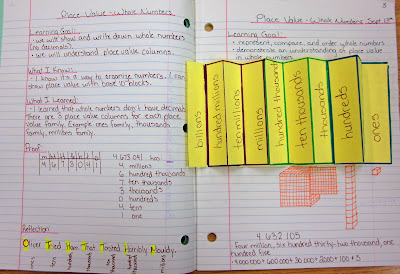
1.  Interactive Math Journals - I always like to introduce new math concepts with an entry or two in our Interactive Math Journals.  I've got some fun ideas here on my blog that you can read some more about.  This one is from my original Interactive Math Journal.  Students identify the place value column of the highlighted digit.  You can see it HERE.
5 Fun Hands-On Activities for Teaching Place Value that your students will LOVE!

Another math journal idea is from my Interactive Math Journal 2.  This one has students identifying the place value columns from billions all the way up to the billions column.  You can read more about it HERE.
5 Fun Hands-On Activities for Teaching Place Value that your students will LOVE!

5 Fun Hands-On Activities for Teaching Place Value that your students will LOVE!
2.  Cup-Stacking Place Value Game - This one is SO much fun!  You need styrofoam cups (or any cups with a lip so you can write a digit on the lip).  Label each cup with a digit from 0-9 (I used a sharpie for this, and I wrote the digit on both sides of the lip).  Repeat for the number of cups you have.  The number of cups you need depend on the number of students playing, and how high you wish your numbers to go.  For a group of 3, playing to the hundred thousands, you will need 18 cups.  (I bought a pack of 20 at the dollar store).  To work with numbers in the billions, students would build a pyramid with 10 cups.


5 Fun Hands-On Activities for Teaching Place Value that your students will LOVE!

Spread the cups out and have your students seated around them.  
5 Fun Hands-On Activities for Teaching Place Value that your students will LOVE!

5 Fun Hands-On Activities for Teaching Place Value that your students will LOVE!As quickly as they can they need to stack 6 random cups in a pyramid, then collapse the pyramid so they have a stack of 6 cups.  The first person to read the 6 digit number the stack makes, wins.  To get all participating and keep the motivation going, you can give the first person 2 points, and everyone else in the group that reads their number correctly 1 point.  Or, you can simply make this a math station without any points at all.  :)  Take a peek at this video to see how we play it.


5 Fun Hands-On Activities for Teaching Place Value that your students will LOVE!3.  Math Stations - Dice, cards, dominos ... all of these manipulatives are great for building numbers to have students work with place value.  I have a fun package of math station sheets for place value that use dice - whole numbers and decimals are included (US and Canadian versions are both included in the resource).  With this Rolling Place Value resource, students will be working with standard, written, and expanded form of numbers.
To use less paper, I bought these great dry-erase pockets at Amazon.  LOVE them.  Just slide the sheet inside, and let the students work.  I'll include an affiliate link to Amazon at the bottom of this post.  If you want to take a peek at this Rolling Place Value Resource, click HERE.
5 Fun Hands-On Activities for Teaching Place Value that your students will LOVE!

I also have a similar resource for rounding - including numbers from millions to thousandths on individual sheets so you can easily differentiate for your students.  Students will also compare and order the numbers they made.  To see this Rolling with Rounding Resource, click HERE.  Each of these two "rolling" resources include an extra page that students can complete and hand in for a formative assessment.
4.  Place Value Scavenger Hunt - I've got a fun little freebie to share with you.  This Place Value Scavenger Hunt has students hunting for numbers - around the school, in a newspaper or magazine, online ... wherever you choose to have your students look.  I'm planning on having my students work in groups, giving each group an iPad.  When they find one of the numbers on their scavenger hunt, they can take a picture of it on the iPad.  At the end of the activity, they will go through their gallery, showing the 15 pictures.  To grab a free copy for your classroom, just click HERE.

5 Fun Hands-On Activities for Teaching Place Value that your students will LOVE!

5 Fun Hands-On Activities for Teaching Place Value that your students will LOVE!5.  Place Value Math Circle - This Place Value math circle is always a hit in my classroom because it gets us up and moving, and really exploring numbers.  It is especially beneficial for the kinesthetic learners in the classroom.  This math circle is similar to my drama circles in that everyone gets a card with a direction to follow.  Each student is given a digit from 0-9, there is a decimal for someone to wear as well.  Once everyone is wearing their digit, the first person reads the instruction on the card and builds the number using people in the class.  For example, in the picture below, the card said, "Use 5 people to build a number with a 2 in the ten thousands place, 4 in the thousands place, 9 in the hundreds place, 6 in the tens place, and 3 in the ones place.  Read the number aloud."  I have both a US version and a Canadian version available.
5 Fun Hands-On Activities for Teaching Place Value that your students will LOVE!

5 Fun Hands-On Activities for Teaching Place Value that your students will LOVE!

And that's about that.  What are some of your best tried-and-true place value activities in the classroom?  Leave a comment below explaining all about it.


7

5 Activities to Teach Mean, Mode, Median

13 July 2016
5 Fun Hands-On Activities to Teach Mean, Mode and Median that your students will LOVE!
Today's 5 Activities to Teach ... is all about Mean, Mode and Median.  Get your students exploring these concepts in an interactive and hands-on way with some of these ideas.

1.  Interactive Math Journals - My favorite journal entry for mean, mode, median and range uses cue cards and a brass fastener.  We write definitions for each of the terms on the cards, then fasten them all together and stick them to the right side of the page.  On the left side of the page, we use a set of data and actually work through solving for mean, mode, median and range.  Getting this done early in the unit gives the students something to reference for the rest of the year when they encounter these concepts.  You can read a little more about this journal entry HERE, or find the full lesson in my Interactive Math Journal 2.

5 Fun Hands-On Activities to Teach Mean, Mode and Median that your students will LOVE!

5 Fun Hands-On Activities to Teach Mean, Mode and Median that your students will LOVE!2.  OREO Day!!! - Ummmm ... math and oreos ... life is good.  This is one of my favorite days in the classroom - hands down.  And it's not even the cookies - it's the stacking competition that I love (OK ... maybe it's the cookies, too).  Students get paired up (each pair needs a package of cookies - I sent a note home asking parents to send in cookies and received more than enough).  Each student then takes a turn stacking.  Rules are - using one hand only, and you cannot move a cookie once it has been placed on the stack.  That's it.  Keep stacking until your tower falls.  The partner not stacking counts the cookies in the stack.  I drew a big chart on the whiteboard to record the # of cookies.  Each person got 2 attempts, so we had a large set of data when complete.  Then, together we found the mean, mode, median and range with the data.  Notes on this activity are included in my Interactive Math Journal, but you can also read more about it in my blog posts HERE and HERE.
5 Fun Hands-On Activities to Teach Mean, Mode and Median that your students will LOVE!


3.  Hey Diddle Diddle - A few years ago I came across a great little rhyme for remembering how to solve mean, mode, median and range.  It is based on the rhyme, Hey Diddle Diddle, The Cat and the Fiddle.  Every time we do a mean, mode and median activity in class, we recite it.  I made a little printable with the rhyme, with a space for you to enter any set of data and room to solve for MMM.  You can grab a copy of it HERE.

4.  Use REAL Data - And use it often.  Don't just teach it and leave it.  Keep the learning going with real data throughout the year.  I like to do "Triple M" assignments (Mean, Mode, Median) whenever we get back testing data - whether it is a small quiz, or larger assignment where percents are given.  It's valuable practice for solving mean, mode and median, and gives students an idea of where their own mark is compared to the average mark in the class.  To do this quickly with grades 4-5, I use the Hey Diddle Diddle printable above, and write the scores in the data box in random order before I photocopy the page.  I also have a few larger assignments that I used with my students in grades 5-7, where students must plot the results on a line plot graph and reflect on the numbers in written prompts.  You can take a peek at those assignments (which also contains editable Word files) HERE.

5 Fun Hands-On Activities to Teach Mean, Mode and Median that your students will LOVE!5.  Stations, Stations, Stations - Again, since coming up with more math stations for next year is my main purpose for these posts, I've got some more station ideas for you.  Pull out the dice or cards and the whiteboards, and give your students a task like "Choose 5 cards and find the mean, mode and median.  Let a partner check your work.  Then switch."  Or "Roll 10 dice to make a set of data.  Find the mean, mode and median.  Then, re-roll two of the dice and see how that changes your data."  Have students complete a number of rounds at each station before moving on.  Add a little more fun to the stations by using a set of "fancy" dice, or giant cards.  I just got a set of huge 5 x 7 cards from Amazon that I can't wait to use (affiliate link at the bottom of the post).
5 Fun Hands-On Activities to Teach Mean, Mode and Median that your students will LOVE!

5 Fun Hands-On Activities to Teach Mean, Mode and Median that your students will LOVE!I also made a set of Mean, Mode and Median Task Cards to use at a station.  This resource includes a full page Minds-On Task which I use to introduce the station, a set of 12 task cards (ranging in difficulty from solving from a set of numbers, to taking the data from a graph, to finding the missing value in a set when given the mode or median), plus a journal prompt you can use for a written or oral response.  It can also be used as an exit slip.  While my students are rotating through their stations, I like to work with small groups at a task card station - and then collect the recording pages for a formative assessment. You can take a peek at this resource HERE or by clicking on the picture below.  

And lastly, if you have computers as a station, this LINK  from Technology Rocks has a few fun online games to practice MMM.  

That's about it for today.  Please leave a comment below if you have a favorite station idea to teach mean, mode and median.  And be sure to check out my other posts for 5 Activities to Teach ... 


0