RUNDE'S ROOM: building better responses

Showing posts with label building better responses. Show all posts

Collaborative Resources as Important Discussion Starters

05 October 2021

With disrupted school years a few years in a row now, I noticed a few important conversations we needed to have much earlier than previous years.  These conversations have focused on being kind, showing our positive character, social media use, and using mindfulness.  Each of these resources or ideas gets your students reflecting on their opinions, feelings, or self-awareness of different attributes and once completed, are the perfect starting points for initiating whole group discussions.  Because students have already reflected on, tried, or talked about the activity, their discussions have been much richer and deeper ... and rewarding.

Runde's Room


My students have spent too much time online - for school AND social media.  I've been trying to reduce or balance the amount of technology my students are using in the classroom at the moment - instead choosing to complete more activities together, through discussions or with good old paper and pencil.  They are also talking about social media WAY more than they used to before.  What they saw, or did, or posted, or watched, or liked ... or whatever.  This Stick-It-Together Collaborative Activity for Social Media will help me start those important social media and internet safety lessons with students ... and will get them sharing their opinions and feelings in small groups, and in writing.  There are over 30 different social media reflection questions (on pros and cons of social media and different apps).  Each student will answer the question on a sticky note independently at first, then groups of 4 students will "stick" their answers together to build their best possible collaborative answer.  When groups are done, allow them some time to share their answers with the whole class - the perfect way to start an important conversation and let students share or defend their opinions.


Some days, thankfully not too many, I also have wondered if my students have completely forgotten ALL their positive character traits, and what makes them the fabulous students they are.  We have gone back to discussing exactly what the positive character traits look like, and how they can show how they are demonstrating them.  This Building Character Stick-It-Together Resource is another way you can have your students working collaboratively to reinforce their good character skills, and brainstorm ways to demonstrate these skills around the classroom and school.


As we have been discussing how important is to BE KIND ALWAYS, I also introduced some kindness rewards into the class.  I purchased some vinyl laptop stickers on Amazon, and added them into my pocket chart for some "Kind Sticks" rewards.  We have a daily kindness challenge posted on the board every morning, and when students complete the challenge, they initial the board.  Right before our last recess, I ask students to share what kind act they did, and how it made them feel.  Sometimes I post individual challenges like, "Do a favour for 3 classmates today", and sometimes it will be a whole class challenge, "Do something well as a class to earn a compliment from a different staff member (not me)".  They are loving these stickers, and are using them to cover their notebooks, folders, binders, and water bottles.


And lastly, I'm not sure if it's just my class, but the ENERGY these kids returned to school with is amazing.  I am exhausted!  They seem like they can just keep going and going and going.  Our energy is usually quite high after we come in for recess or after lunch, and it's taking a bit to settle after transitions.  I knew I wanted to start some mindfulness activities in the classroom, so I created a Cursive (and Printing) Writing Practice Mindfulness Activity (because multi-tasking is my life ... even during mindful moments).  The resource also contains all the same sheets for regular printing practice as well). These pages will give your students explanations for mindfulness as well as many short mindfulness tips and activities they can try in the classroom and outside of it.  With so many of our students needing a little extra mental health self-care, using mindfulness is a wonderful way to reduce anxiety, stress, and learn to self-regulate better.


0

Reading Response Activities for Wonder

16 February 2016
Runde's Room - Reading Response Activities for Wonder
If you follow me on Instagram, you already know that we have just finished Wonder by RJ Palacio as our read aloud ... but not wanting to give up Auggie just yet, we're reading The Julian Chapter from Auggie and Me.  A few people have asked me about what we did during our reading of the novel, so I decided to put together a blog post with some of our favorite activities.

For our daily read aloud, I usually read for about 10 - 15 minutes a day.  I don't do a reading response for our read aloud every day - usually about 2 to 3 a week, though (through our independent and shared reading, they have a lot comprehension and response minilessons so we have other avenues for practice).  I also like to switch up our format a bit - bored learners are not engaged learners.  We do have a reading response notebook where we do a lot of our responses, but we like to use other formats as well.

Runde's Room - Reading Response Activities for Wonder
We completed one of our first favorites early on in the novel, and was a great tie-in to teaching empathy.  Perhaps you've seen images from an anti-bullying lesson and crumpled paper - that one stuck with me from the minute I saw it.  (There are many examples all over the web, but you can read a little more about it HERE.)  I knew it would be a great lesson to go along with Wonder.  We talked about how it would feel to be Auggie - to have people stare and call names.  I then handed out a small piece of paper to each student.  I told the students to call the paper names and say mean things to it - the kinds of things Auggie may have overheard.  They were to crumple the paper in a ball as they were doing this, being responsible for the paper getting smaller and smaller and more destroyed.  I then had them apologize to the paper, over and over, as they tried to smooth it out and make it "better".  We talked about how the paper never went back to the way it was before - even when they tried to make it better, the marks and scars were still visible.  They thought this was pretty powerful.  I then had them use this paper to do their reader response on.  I asked them three questions to respond to on the paper:
  • What did we do?
  • What did you learn?
  • How can you connect this activity to Auggie in Wonder?

Runde's Room - Reading Response Activities for WonderSometimes I just changed up the way we answered questions, instead of having them answer in their notebooks.  I would write a quote on the whiteboard and they could respond right on the whiteboard, or use sticky notes to take notes while I was reading and post them after, and I also used a lot of printables from my Building Better Reading Responses and Stick-It-Together editable templates because they reinforced the reading response goals we were working on.  I didn't have a set list of questions from the novel to choose from, instead, I came up with a question after our reading each day, thinking about the parts that really seemed to stick with the students or became great discussion starters.  (You'll see color coding on some of our reading responses - this comes from our Reading Response Goals from my Building Better Reading Responses resource.)
Runde's Room - Reading Response Activities for Wonder

Runde's Room - Reading Response Activities for Wonder

Runde's Room - Reading Response Activities for Wonder

Runde's Room - Reading Response Activities for Wonder

Runde's Room:  Wonder Comprehension QuestionsI have a Stick-It-Together Novel resource full of comprehension questions for Wonder that cover a variety of reading skills.  These collaborative reading responses are my absolute favorite group work activity.  Each student is first accountable for writing their own answer on a sticky note, and then they work to "stick together" their answers to build the best collaborative answer containing parts of their own original answers.  Using these pages on a regular basis really helps your students reading responses improve - the more the students worked collaboratively to revise their best answers, the more they included these kinds of revisions in their own answers.  Click HERE or on the picture to take a peek at this resource.
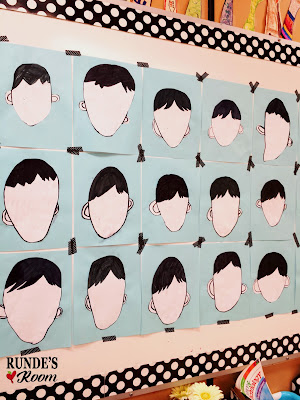
Runde's Room - Reading Response Activities for WonderFor our summative activity for the book, our last reading response, I knew I wanted to do something special.  We started by doing directed drawings of the face shape on the cover of the book.  I gave each student a piece of white paper, and just told them what to draw from looking at the image.  For example, I said, start out by drawing a large oval in the middle of the page, with the top being a little flatter than the bottom.  For the hair, make an upside down V about an inch from the top of the oval, a little to the right of the middle.  I was also drawing the same picture on the board as I was giving the instructions, so they had something to follow along.  When we were done we cut out the face shapes and glued them to a piece of blue paper. We loved how these turned out!

Our last reader response question was based on a event from Auggie's graduation.  I wrote this on the board:
Runde's Room - Reading Response Activities for Wonder
  -  At the end of Wonder, Mr. Tushman said, "Greatness lies not in being strong, but in the right using of strength.  he is the greatest whose strength carries up the most hearts ...".  Auggie won the Beecher medal because this quote applies to him.  Explain, using evidence from the text, what this quote means and how it applies to Auggie.  How did he use his greatness to make others great?  It was a pretty deep question for my grade 4/5 class, but we've had many deep conversations throughout the novel, and they ROCKED it.  Super proud teacher moment.
When they were done the rough drafts of their responses, they wrote their good copies right on the faces (they drew lines in pencil to write on).  These turned out so wonderful!  They made a great celebration and evidence of learning bulletin board, appropriately entitled, Choose Kind.  :)  

Runde's Room - Reading Response Activities for Wonder

When you're reading a book that has so many great lessons, you just feel inspired to come up with some great lessons of your own.  :)

Runde's Room - Reading Response Activities for Wonder

And lastly, a fabulous way to wrap up the unit is having your students perform this super fun Wonder Drama Circle.  Your students will LOVE getting to act out small parts of the novel, and they get to work on their oral fluency skills at the same time.  Win.
I'd love to hear about some of your must-do lessons to go along with Wonder.  Leave a comment below about something you do in your room.

9

Scaffolding the Learning

26 July 2015


It's getting pretty close to back to school time again (and it's already that time for some of you).  Don't panic.  I've gotten together with some of my best upper grade blogging friends to create a back to school survival guide full of our best tips and tricks for you.  So ... relax and breathe.  And then breathe again.  We're all in this together.

If you are a brand new teacher, or are starting a new grade level this year (like I am), one of the first things you do is start to scour the curriculum to see the expectations and standards you need to cover.  And usually the second thing you do is start to panic, wondering how you are going to fit it all in and tie it all together in a neat little package so that your students are demonstrating their learning in those perfect little constructed responses that are required. The most important thing to remember is that these standards and expectations and constructed responses are something that students should know by the END of the year (or by testing time, which is often sooner ... but that's a post for another day).  You (and your students) have TIME to get there.


Scaffold the Learning:
Although you do need to start out right away teaching the expectations and standards, you don't need to expect full constructed responses from your students right away.  Let them start slow - their brains are hard at work learning the new concepts - give them a chance to master the material first.

When I do start them on constructed responses, I start out with one simple step.  I introduce our first response learning goal by the second week of school - and I keep it easy by starting with "start with part of the question in your answer" in reading and "plan your organization" in math.  We talk about why each learning goal is an important part of the constructed response, and we color code these parts when practicing our responses.

I scaffold the learning by introducing one step at a time, and give them time to master it before adding a second step.  This way the students aren't struggling to remember all the steps to constructed responses as well as the lesson standards and expectations for the concepts taught.  I keep a bulletin board of these learning goals (our response learning goals) and we slowly add to them each time I introduce a new goal (adding a new goal about every two weeks or so).  By January, we have a complete set of learning goals for our constructed responses, giving the students the rest of the year to practice combining the concepts they've learned with their constructed responses learning goals.  And by keeping the learning goals posted (written in the color they should use to color code their responses) they have a reference they can use independently to improve their responses.  By having them color code their responses, I find it increases student accountability and accuracy incredibly - they know what is missing from their responses and have time to add to their answers before handing something in for assessment.

Our first learning goal for responses in reading is "start with the question".  It gets posted on our bulletin board.  As we continue to add learning goals over the coming weeks, I place each one on the bulletin board below the one before it.
Our first learning goal for constructed responses in math is to "plan your organization".  This starting point helps them think about how to show their solutions in a neat and organized way that makes it easy to read (and assess).  Again, like in the reading, we continue to add learning goals to this bulletin board.


By January, our boards are a lot fuller and look more like this ...


The wonderful thing about scaffolding the learning is that you can work at the pace your students need - they will not get left behind.  Because you have time, you can spend longer on a certain area that your students have not mastered yet.  And because everyone continues to work on the same goal, there can be a lot of peer collaboration and helping in the classroom.  I like to do a lot of "turn and talks" where the students discuss with a neighbor how they will include the new learning goal in their answer and show each other what they have written.

You can read a little more about the strategies I use and see some of our work along the way in other blog posts I have written about this step-by-step process to building better responses.  Click HERE to see our scaffolded reading goals in action, and HERE to see our scaffolded math goals in action.  Each blog post also contains links to other blog posts I have written about this process.

You can create your learning goals based on the needs in your classroom, or if you're interested, I have made ready-to-use resources for scaffolding the learning that contain all the learning goals, posters, book marks, reflection sheets, scaffolded handouts, assessment ideas and activities for the students.  These are some of my most favorite resources I've created and they are invaluable in my classroom.  Click on any of the resources below or on the picture to the right to see a preview of my Building Better Responses resources.


Be sure to visit the blogs below to read their best Survival Tips, as well.  Have a GREAT start of the year!!!


2