RUNDE'S ROOM: reading activities

Showing posts with label reading activities. Show all posts

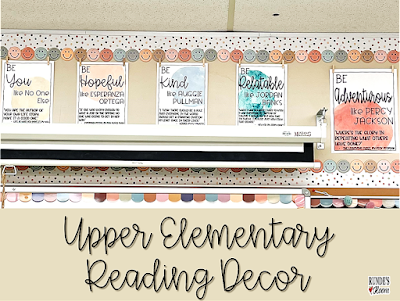
Character Affirmation Posters: Purposeful Reading Decor for Your Upper Elementary Classroom

24 August 2023

As I've said in previous posts, I love decorating a classroom, but those decorations need to have a purpose.  I leave a lot of empty space on my bulletin boards at the beginning of the school year so the students can fill the walls with their learning.  So, when I do take up that precious wall space, the decor has to have purpose for my upper elementary classroom.


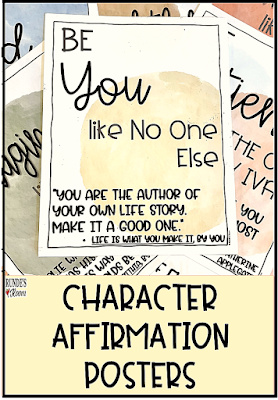
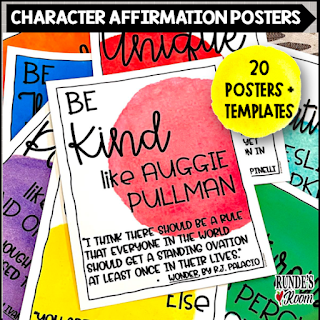
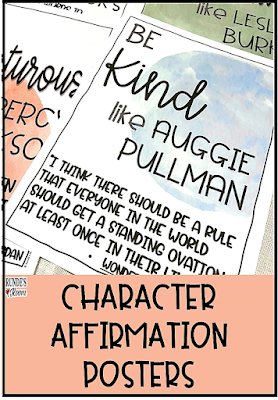
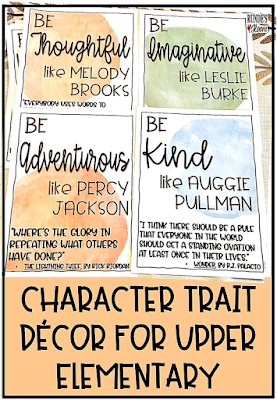
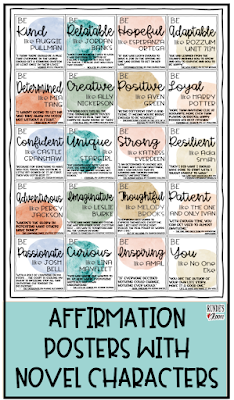
These Character Affirmation Posters are perfect!  Bridging literature and character growth, these positive affirmations for my students are linked to some of their favorite main characters in popular novels for upper elementary and middle school classrooms.  Not only will these posters hopefully inspire my students to check some of these books out on the shelves, but they are also a great model when analyzing characters and writing reader responses because they describe the character with a trait and give supporting evidence from the novel.  I know I'm going to refer to these all the time.


There are 20 posters included in this resource.  As a bonus, there are also 8 blank templates students can use to create their own character affirmation posters for their independent reading, or empower a classmate with a positive affirmation poster celebrating their strengths. Whether it's celebrating a classmate's kindness or portraying their personal growth journey, these templates encourage creativity and collaboration within the classroom.


Designed on 8.5 x 11 paper, these posters can also easily be enlarged to 11 x 17 on a photocopier - I need both sizes for my bulletin board.


 **Key Features:**

- 20 Character Affirmation Posters: Fuel character growth through evidence-based positive affirmations.

- Literary Connections: Connect students' favorite characters with real-life values and traits.

- Evidence from Text: Strengthen character understanding with quotes directly from the novels.

- Classroom Enhancement: Elevate your learning environment with purposeful decor.

- 8 Customizable Templates: Foster creativity and collaboration among students.


You can take a peek at these Character Affirmation Posters in my TpT store by clicking HERE or on any of the pictures.

I also have a bright and bold version of these beautiful posters.  Click on the picture below to see them.  And ... each of the previews on TpT contain one full poster and one full template poster if you wanted to try this activity with your class.


0

Elevate Learning with Drama Circles: The Ultimate Novel Study Culminating Activity

03 July 2023


Are you tired of the routine book reports and presentations for novel studies? Do you dream of adding an engaging, interactive, and imaginative twist to your novel read aloud? Well, if you haven't heard of them before, welcome to the world of Drama Circles, an incredible tool that can take your novel study culminating activity to new heights.


Breaking down Drama Circles

I started to make drama circles over 20 years ago for my classroom.  Over the years, my drama circles have evolved from random fun topics that got my students building confidence in drama activities, to a more engaging and kinesthetic activity, offering students a new way to delve into their favorite books or learn more subject-based content.


Why Drama Circles?

Now, you might be wondering, why Drama Circles? How do they provide more value than a traditional book report or worksheet?


1. Active Participation

Firstly, Drama Circles encourage active participation, acting as a great student engagement strategy. Each student plays an integral part, making them feel responsible for their contribution and promoting active learning.  They must follow along (encouraging active listening skills), then follow the instructions on their card to perform once it is their turn.


2. Develops Social-Emotional Skills

Drama Circles are wonderful for building social-emotional skills. They foster empathy as students step into the shoes of different characters, experiencing their struggles, joys, and dilemmas. This is particularly impactful with books like "Wonder," which delve into themes of acceptance and kindness.


3. Enhances Comprehension

By acting out scenes from the novel, students deepen their understanding and comprehension of the plot. Becoming the characters, explaining their motivations, and acting out the conflicts, makes novels like "The City of Ember" or "Harry Potter and the Philosopher's Stone" more vivid and engaging.


4. Creativity and Imagination

Unleashing their creativity, students reimagine scenes from novels, add dialogue, and even craft new scenarios. This is a powerful exercise that fires up their imagination, making the learning process fun and exciting.


5. Boosts Confidence 

Standing up in front of the class, performing and expressing oneself helps students improve their communication skills, boosts their self-confidence, and reduces stage fright.  And this is a great thing to remind them of when they are nervous about an upcoming oral presentation - look what you've already done in the classroom!


Implementing Drama Circles in Your Classroom

You can kick-start Drama Circles in your classroom by trying one out at the end of your novel study.  They are easy and no-prep - just print, cut out the cards, and go!  Assemble your students in a large, standing circle (you can do this in the classroom by moving around some desks).  Hand out the cards, in random order, to all students in the class.  Depending on your numbers, some students may have more than one card.  (This is where your 'teacher wizardry' comes in - match the amount of dramatic activity and difficulty of lines to the student's ability as you hand out the cards.  As the lines are bolded on the cards, this is very easy to do quickly).  After you hand out the cards, allow a few minutes for students to read over and plan their moves - they may also want to check with a peer beside them if they have any questions about the words or the meanings.  And then, that's it.  Have the person with the first card step into the middle of the circle and start the drama.  Students do not read out the card numbers, and they only read out the bolded lines on the card.  The actions are not in bold, they are simply to be performed.  Students must listen and follow along so they know when their part is, however, if a student misses their line, the cards are numbered so you can easily pick up where you left off.


Take a step back and allow the children to steer the action. You'll be amazed at how they interpret the text, bring it to life, and, in the process, deepen their understanding of the novel.  And you'll be even more amazed as some of your shyest students come of their shells.


If this is their first drama circle, students sometimes start a little shy.  However, it is amazing to watch how quickly the students catch on and how popular the drama circles become with a little practice as the format for every drama circle is the same.  One teacher friend said, "My students loved these!! They would beg to do them. It was so wonderful to see kids come out of their shells to act out parts. My 5th graders could be a tough crowd at times but they ALL laughed and had fun together during these. Some of my favorite moments from the school year!"


Wrap-up 

Why show a movie at the end of your novel study when you can get your students out of their seats, improving their comprehension and presentation skills, and maybe even grab a drama mark or too (yes, a rubric is included) with a drama circle?  Trust me.  They'll like them.


Take a peek at my new (with more being added all the time) line of Drama Circle Novel Culminating Activities by clicking HERE or on some of the titles below:

0

5 Activities for October in the Upper Grade Classrooms

17 October 2021

Activities for October in Upper Grade Classrooms

I love everything about the Fall.  It's the perfect combination of weather, beauty, and all things cozy.  It's also one of my favourite months in the classroom.  We're starting to get our routines down pat, beginning of the year assessments are complete (or almost ... haha), and our classroom community vibes are pretty strong.  We can start to handle some more engaging and hands-on activities ... and in my opinion, there is no better month to do it.  


Falling into Poetry Writing and Figurative Language Activities
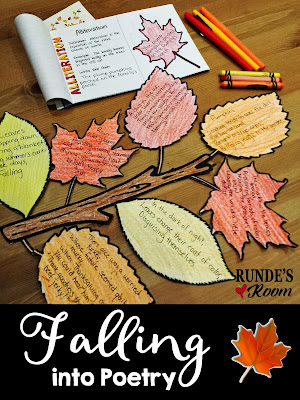
1.  Fall Poetry Books
- Falling into Poetry is easy with this resource that's perfect for the beginning of the year when the leaves start to change.  Students get an introduction to many different forms of poetry, as well as figurative language.  There are examples of each type of poetry and figurative language device, as well as space for students to complete their own examples.  Completed pages turn into a beautiful poetry mini book.  Each poetry form also has a leaf outline so students can copy their best poems onto the leaf and colour for display.  There is a branch included for each student to make their own little poet-tree, or individual leaves could be added to a bulletin board, kraft paper tree in the classroom, or REAL branches for a gorgeous autumn display.  

I have also integrated this into an art activity, where students paint a Fall background on a page, then choose 2 -4 completed poem leaves to glue down onto the background for a beautiful writing and art piece.  Click either picture to take a closer peek at this resource in my store.


2.  Clay Sculpted Leaf Art - Every year I look forward to decorating my classroom with gorgeous Fall Leaf Art.  For these beautiful Fall Leaf bowls, we used air dry clay.  I had students pick a real leaf from the school ground (a fallen leaf, of course) - one they felt they could trace.  Students were each given some air dry clay to flatten out to about 1/4 of an inch thickness (and just slightly larger than the leaf they chose).  Note - be sure to have them work with the clay on some type of paper, it's no mess that way.  Students then used a pencil to trace around their leaves on the wet clay, and then used a plastic butter knife to "cut out" their leaves and draw on the veining (copying their real leaf).  When done, we put them vein side down, over some crumpled up paper to sort of form the leaves into a slight bowl shape.  It takes about 3 - 4 days to fully dry.  Once dry, paint (we used acrylic paint) the leaves in gorgeous Fall colours.  Experiment a bit with this.  Using a toothbrush to splatter some of the paint on top makes very realistic spotting on the leaf - and practice mixing and blending with colours.  We sealed our leaves with a spray varnish when complete, but you don't need to do this step.


Fall Leaf Art Lesson

3.  More Leaf Art -
This Fall Leaf Art Lesson is perfect to study line, shape, form, and colour with the elements of design.  Students will trace 2 - 4 leaves on their page, then fill the rest of the page with concentric circles (if you're brave you can have students use a compass, or use the page I included with the circles already drawn).  Choose 3 or more warm colours for the leaves, and colour each section made (by the circles) in a pattern.  When the leaves are coloured, choose 3 or more cool colours for the background, again alternating colours in a pattern.  The leaves look like they're falling against a beautifully windy sky backdrop, or falling into a pool of water.


October Literacy 3D Activities

4.  ALL the Craftivities
- While I do love to sneak in my 3D craftivities at different points in the year, I have to admit, all the Fall ones top my list.  These activities make the perfect station activity, or independent work activity so you can meet with small groups or get some assessment done while students are hard at work.  Each one takes approximately one week.  I usually have students finish 2 questions (2 panels) from Monday - Wednesday.  On Thursday they colour all the panels, and then Friday is assembly day.  I have craftivity packages for both literacy and math.  The October Literacy 3D Craftivities Bundle has two different book report resources covering story elements and reading comprehension (the pumpkins and the ghost), as well as a fun one for synonyms and over-used words.  The Fall Math Review 3D Activity Bundle has a candy corn place value review, as well as a pumpkin pie shaped activity with word problems (about pumpkin pies, of course).  Click on either title or picture to the right to see these resources in my TpT store.

Fall Math Review 3D Activity Bundle


5.  Fall Drama Circle
- You can't have all that Fall beauty without a little drama. ;)  A drama circle, that is.  This is a new drama circle with a Fall theme - make a circle, hand out the cards, and have some fun.  If the weather is nice, this one is even better outside!  All drama circles now contain colour and black and white copies, and a observation rubric for assessment of drama skills.  Click HERE or on the picture below to take a peek.

Fall Drama Circle
Fall Activity Bundle for Upper Grade Classrooms

You can find all of these Fall-themed resources in one bundle that can take you through the month of October in your classroom.  You can out my Fall Activity Bundle HERE, or by clicking the picture on the right.

Candy Corn Decimals Printable
And lastly, if you made it all the way to the bottom, reward yourself with this little Candy Corn Decimals Place Value Printable.  Just click on the picture to the right to grab a copy for yourself.  Happy Fall, Y'All!


1

Theme Day - Book Buffet

06 July 2016
A Book Buffet Theme Day to celebrate the LOVE of reading!
If you're looking for a fun theme day dedicated to the LOVE of reading in your classroom, a book buffet day may be the perfect fit.  This was another one of our end of the year theme days this year, but a day dedicated to the love of reading ... happy sigh ... well, it would be perfect at any time during the year.

To get things started, I asked the students to pick their favorite book from independent reading this year.  It could be any genre, and read at any time over the school year.  I was surprised by some of their choices, but when I saw all the books altogether, it just made me happy.

And here they are - my grade 4/5 students' favorite independent reads from the year:
A Book Buffet Theme Day to celebrate the LOVE of reading!
A Book Buffet Theme Day to celebrate the LOVE of reading!Once we had our faves collected, I told the students they would be writing a Book Love Note - a little sticky note explaining why they love the book they picked.  We started our notes "To the next person that reads this book ..." and then they filled in the rest.  They stuck the notes in the fronts of the books, and then we took a moment to let each student read their note to the class.  I LOVE the idea that my class next year will find all these little love note treasures when they're searching through my classroom library next year.  
A Book Buffet Theme Day to celebrate the LOVE of reading!
A Book Buffet Theme Day to celebrate the LOVE of reading!  Spread the love with these book love notes.In fact ... I LOVED their little notes so much, I just made a little "Book Love Note Nook" to keep on top of my bookshelves next year so I can keep the love going.  I even found some fun little heart-shaped sticky notes to use for it.  We won't limit our love notes to one day next year; students can write a book love note whenever they feel they need to "share the love".  I made this little "Book Love Notes" graphic and uploaded it took google drive in case you'd like to grab a copy for your own class.  You can download it HERE.

A Book Buffet Theme Day to celebrate the LOVE of reading!After writing and talking about how much we love books, well ... we had to READ!  I told students they could bring in blankets and pillows for the day, if they wished, and I let them make up comfy little nests to read in ... which soon turned into comfy little forts.  Some brought in flashlights, too.  So, all curled up, we started to read.  We read for 1/2 an hour ... and did this 3 times throughout the day (once during each of our 100 minute blocks of our day).  It was awesome!
A Book Buffet Theme Day to celebrate the LOVE of reading!Next up in our big book buffet, was a fun book raffle.  I had a big box of books discarded from the library, and students brought in some of their old books to trade, too.  We put all the books in the middle of the room, and then I started to draw names.  When their name was drawn, they could pick a book.  After each round, I gave them 15 seconds to make a trade with something left in the middle.  We were able to go through about 3-4 rounds of books, and everyone went home with some "new to them" books.
To finish up our book loving buffet, we did a drama circle I've been working on ... with a theme none other than READING, of course.  I LOVE watching my students perform drama circles - it always brings us closer together.  You can take a peek at my newest drama circle by clicking HERE or on the picture to the right.  What an awesome day of celebrating our love of reading.  And I know my students enjoyed it just as much as I did!


6

Reading Response Activities for Wonder

16 February 2016
Runde's Room - Reading Response Activities for Wonder
If you follow me on Instagram, you already know that we have just finished Wonder by RJ Palacio as our read aloud ... but not wanting to give up Auggie just yet, we're reading The Julian Chapter from Auggie and Me.  A few people have asked me about what we did during our reading of the novel, so I decided to put together a blog post with some of our favorite activities.

For our daily read aloud, I usually read for about 10 - 15 minutes a day.  I don't do a reading response for our read aloud every day - usually about 2 to 3 a week, though (through our independent and shared reading, they have a lot comprehension and response minilessons so we have other avenues for practice).  I also like to switch up our format a bit - bored learners are not engaged learners.  We do have a reading response notebook where we do a lot of our responses, but we like to use other formats as well.

Runde's Room - Reading Response Activities for Wonder
We completed one of our first favorites early on in the novel, and was a great tie-in to teaching empathy.  Perhaps you've seen images from an anti-bullying lesson and crumpled paper - that one stuck with me from the minute I saw it.  (There are many examples all over the web, but you can read a little more about it HERE.)  I knew it would be a great lesson to go along with Wonder.  We talked about how it would feel to be Auggie - to have people stare and call names.  I then handed out a small piece of paper to each student.  I told the students to call the paper names and say mean things to it - the kinds of things Auggie may have overheard.  They were to crumple the paper in a ball as they were doing this, being responsible for the paper getting smaller and smaller and more destroyed.  I then had them apologize to the paper, over and over, as they tried to smooth it out and make it "better".  We talked about how the paper never went back to the way it was before - even when they tried to make it better, the marks and scars were still visible.  They thought this was pretty powerful.  I then had them use this paper to do their reader response on.  I asked them three questions to respond to on the paper:
  • What did we do?
  • What did you learn?
  • How can you connect this activity to Auggie in Wonder?

Runde's Room - Reading Response Activities for WonderSometimes I just changed up the way we answered questions, instead of having them answer in their notebooks.  I would write a quote on the whiteboard and they could respond right on the whiteboard, or use sticky notes to take notes while I was reading and post them after, and I also used a lot of printables from my Building Better Reading Responses and Stick-It-Together editable templates because they reinforced the reading response goals we were working on.  I didn't have a set list of questions from the novel to choose from, instead, I came up with a question after our reading each day, thinking about the parts that really seemed to stick with the students or became great discussion starters.  (You'll see color coding on some of our reading responses - this comes from our Reading Response Goals from my Building Better Reading Responses resource.)
Runde's Room - Reading Response Activities for Wonder

Runde's Room - Reading Response Activities for Wonder

Runde's Room - Reading Response Activities for Wonder

Runde's Room - Reading Response Activities for Wonder

Runde's Room:  Wonder Comprehension QuestionsI have a Stick-It-Together Novel resource full of comprehension questions for Wonder that cover a variety of reading skills.  These collaborative reading responses are my absolute favorite group work activity.  Each student is first accountable for writing their own answer on a sticky note, and then they work to "stick together" their answers to build the best collaborative answer containing parts of their own original answers.  Using these pages on a regular basis really helps your students reading responses improve - the more the students worked collaboratively to revise their best answers, the more they included these kinds of revisions in their own answers.  Click HERE or on the picture to take a peek at this resource.
Runde's Room - Reading Response Activities for WonderFor our summative activity for the book, our last reading response, I knew I wanted to do something special.  We started by doing directed drawings of the face shape on the cover of the book.  I gave each student a piece of white paper, and just told them what to draw from looking at the image.  For example, I said, start out by drawing a large oval in the middle of the page, with the top being a little flatter than the bottom.  For the hair, make an upside down V about an inch from the top of the oval, a little to the right of the middle.  I was also drawing the same picture on the board as I was giving the instructions, so they had something to follow along.  When we were done we cut out the face shapes and glued them to a piece of blue paper. We loved how these turned out!

Our last reader response question was based on a event from Auggie's graduation.  I wrote this on the board:
Runde's Room - Reading Response Activities for Wonder
  -  At the end of Wonder, Mr. Tushman said, "Greatness lies not in being strong, but in the right using of strength.  he is the greatest whose strength carries up the most hearts ...".  Auggie won the Beecher medal because this quote applies to him.  Explain, using evidence from the text, what this quote means and how it applies to Auggie.  How did he use his greatness to make others great?  It was a pretty deep question for my grade 4/5 class, but we've had many deep conversations throughout the novel, and they ROCKED it.  Super proud teacher moment.
When they were done the rough drafts of their responses, they wrote their good copies right on the faces (they drew lines in pencil to write on).  These turned out so wonderful!  They made a great celebration and evidence of learning bulletin board, appropriately entitled, Choose Kind.  :)  

Runde's Room - Reading Response Activities for Wonder

When you're reading a book that has so many great lessons, you just feel inspired to come up with some great lessons of your own.  :)

Runde's Room - Reading Response Activities for Wonder

And lastly, a fabulous way to wrap up the unit is having your students perform this super fun Wonder Drama Circle.  Your students will LOVE getting to act out small parts of the novel, and they get to work on their oral fluency skills at the same time.  Win.
I'd love to hear about some of your must-do lessons to go along with Wonder.  Leave a comment below about something you do in your room.

9

Adding Student Evidence to Learning Goals

12 January 2016
I've been using my Building Better Responses Goals and Resources for a few years now, and they are one of my absolute favorite resources to use in the classroom because they just work for my students.  And they prepare the students for testing better than anything else I have used.  But, something new I've been doing this year is adding a student evidence piece alongside the goal - proving the mastery of the goal.  I am loving how this small change has excited my students and motivated them to work even harder.  It's an awesome thing to see.

If you are new to my Building Better Responses resources, you can read a little more about them in blog posts I have HERE and HERE.  Basically, it's our system of scaffolding the learning goals needed to compose a well thought out response - to reading, writing, or math questions (I have resources for all 3).  Students use colors to code their work - showing exactly where they have included each learning goal in their answer - actively monitoring their thinking and analyzing and reflecting on their strengths and areas of need.

There are many ways to use the better response goals, but in my class, I teach them whole group - starting with the first goal and slowly adding to them - usually adding a new goal about every two or three weeks - this really allows for mastery at each step.  And each time my students show mastery of a goal, I add an evidence piece to the space on the board beside the goals.

 I post both my reading and math response goals on a small section of whiteboard, separated with some washi tape. (I finally found a use for washi tape!)  Each time we add a new goal, I model what a response should look like, and we talk about how we would color code the evidence in our answer.  The evidence piece always comes from student work - it is not a copy of an answer I've modelled - that doesn't show mastery of anything except the ability to copy from the board.  ;)

The first time I chose evidence pieces from the students - ones where they had really shown mastery of the goal, the students were very surprised ... and a little proud, too.


So, we kept it going.  We've recently added our fourth reading response goal and third math response goal, and I can't believe how well the evidence piece is working for my students' motivation.  Each time we do a response, my students work SO HARD to have their work chosen as the evidence piece, and they are so excited to share their work with me (and sometimes I add more than one evidence piece simply because it was too hard to choose ... and so more students have the opportunity to have their work shared - and all students will make it onto this board at some point through the year).  Most of the time their responses are written with resources from the Building Better Responses resource or my Stick-It-Together resources (the better responses and stick-it-together pair very well together), but really, any form of response would work well.


I am so proud of the work they've been doing - and I know when they see their work showcased like this, they're proud of themselves, too.


6