I started using Numberless Word Problems in my math classes late last year, and immediately, I was hooked. I loved how it made my students look at work problems in a different way - they really had to think about what the problem was asking ... and develop a plan to solve it - without being distracted by the actual numbers in the problem, or just taking the numbers in the problem and adding or multiplying them together. The conversations that were happening between my students were fascinating - they were far more willing to take risks with their partners or small groups because the numbers were eliminated at first - students weren't worried about their math skills, or getting the "answer" wrong. Engagement was definitely high and students were eager to share what strategies they used to "solve" the numberless problems.

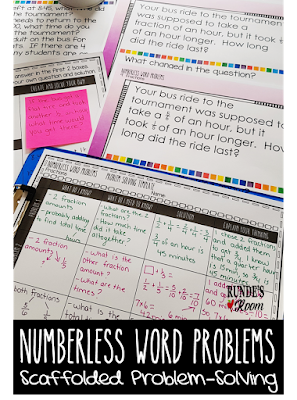 Numberless word problems are an excellent way to get your students thinking about WHAT the word problem is actually asking them to do and developing strategies for solving the problem. Using these kinds of word problems provides the essential scaffolding that helps students develop a stronger understanding of how the numbers work together and how to make a plan to solve the problem.
I would use these problems as a mini-ish lesson (takes a little longer than the 10 minute lesson) when beginning a particular concept (operations, measurement, fractions, etc.), when teaching a problem-solving strategy (using smaller numbers, simpler problem, identifying the operation, etc.), or when practicing algorithms or strategies for multiplication and division. These are great for differentiation when practicing these strategies because students are working with "their own" numbers for the first problems; encourage students to use numbers that are reasonable, but that they are comfortable working with.
 I would do these activities as a whole class - projecting the problems so everyone could see. I would display the first slide - a chosen problem with all numbers removed like the example on the right. You can make up a problem or use any word problem you have that fits your learning goal for numberless word problems (grab a textbook or worksheet) - just remove the numbers - and make sure you separate the problems (don't have all 3 on one page - students shouldn't see the third problem until the very end).
After I displayed the slide I would them let my students talk (or use whiteboards or their journals) with their elbow buddy or small group, asking:
 I would then show the second problem - same problem, same question, with some information added to it. This time students discuss:
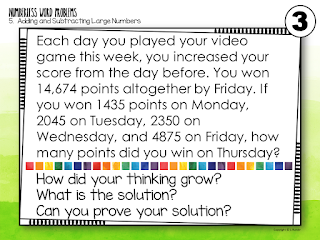 The third problem I show has all the information they need to solve the problem. But instead of having students work with their partner or small group, I have them work independently for the first few minutes ... then I usually allow them to partner up - making sure they "prove" their solution to each other. That independent part is important to help them become risk-takers and attempt difficult things and use their problem-solving strategies and make a plan to start ... and all those great things we want them to do when working independently. I choose one or two pairs or groups to share their work at the end and model how they solved the problem.

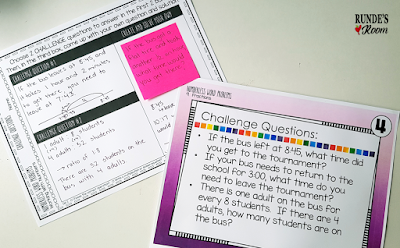 I've been making some Numberless Word Problem resources to use in my classroom. Each resource contains 10 different scaffolded problems, plus an extra "challenge" page that has 3 - 4 more word problems (not numberless) that review other math concepts related to the word problem. There are also problem-solving templates, learning goal and success criteria to display, and an answer key. Each resource also contains a self-reflection form, as well as peer and teacher feedback forms for formative assessment opportunities, and a rubric for more formal assessments. Having students actively use the feedback forms to make improvements on their next problems by explaining how they used the feedback on their self-reflection forms makes these word problems an excellent portfolio piece or piece of assessment evidence.
You can take a peek at these resources by clicking HERE:


0


I would use these problems as a mini-ish lesson (takes a little longer than the 10 minute lesson) when beginning a particular concept (operations, measurement, fractions, etc.), when teaching a problem-solving strategy (using smaller numbers, simpler problem, identifying the operation, etc.), or when practicing algorithms or strategies for multiplication and division. These are great for differentiation when practicing these strategies because students are working with "their own" numbers for the first problems; encourage students to use numbers that are reasonable, but that they are comfortable working with.

After I displayed the slide I would them let my students talk (or use whiteboards or their journals) with their elbow buddy or small group, asking:
- "What do you know about the problem?" (here I would look for answers like numbers are increasing per day)
- "What do you need to know?" (what are the points? is there a pattern? how many points on Thursday?)
- "What is a possible solution?" (here I ask the students to try to come up with an equation related to the learning goal (in this case - adding and subtracting large numbers) using their own set of reasonable numbers - they may come up with something like 100 + 200 + 300 + _____ + 500 = 1500, or 250 + 300 = 500, or something completely different.) At this point I ask students to share some of their equations with the class and we discuss if the answer makes sense and if it is reasonable. This is a great time to check for misconceptions, too - make sure students understand the importance of the word increasing ... and that we are looking for a specific answer for a specific day.

- "What changed in the problem?" "Does this change your equation?" How?"
- By asking them again, "What do you need to know?" they narrow down what information is still missing and realize that the actual question they need to solve did not change, but HOW they go about solving the problem may change - they may need to change their equation (here I would look for students realizing this was a multi-step problem - that they would probably have to add points together and subtract from the total to find Thursday - reminding students of the learning goal while they work through these questions often helps them with choosing the correct steps).
- Students work with their partners to change their original equation (either by substituting in the new information for their number and re-evaluating, or by using a new equation altogether. Again, students are asked to share how their thinking evolved or what made them change their thinking.


 I've been making some Numberless Word Problem resources to use in my classroom. Each resource contains 10 different scaffolded problems, plus an extra "challenge" page that has 3 - 4 more word problems (not numberless) that review other math concepts related to the word problem. There are also problem-solving templates, learning goal and success criteria to display, and an answer key. Each resource also contains a self-reflection form, as well as peer and teacher feedback forms for formative assessment opportunities, and a rubric for more formal assessments. Having students actively use the feedback forms to make improvements on their next problems by explaining how they used the feedback on their self-reflection forms makes these word problems an excellent portfolio piece or piece of assessment evidence.
You can take a peek at these resources by clicking HERE: